

A notarized letter is a written statement whose signing has been witnessed by a notary public, who checks the signer’s identity, confirms the signer is acting willingly, and certifies the signature with an official seal or stamp. Think of a notary as a neutral witness stationed between a letter and the person who needs to trust it. They check ID, watch the signature happen, and stamp a record that it did.
Notarization confirms that the signing took place under those conditions. It does not confirm that what the letter says is true.
This article explains what is a notarized letter, when important documents require notarization, and why a notarial act can add legal weight to a signed document. You’ll also learn how to notarize a letter using SignNow.
TL;DR
- A notarized letter is a document that a notary public has witnessed being signed, after verifying the signer’s identity and willingness.
- Notarization authenticates the signing process, not the accuracy of the letter’s content.
- Common notarized letters include letters of authorization, travel consent letters for minors, letters of residency, and financial or employment verification letters.
- A properly notarized document is self-authenticating as evidence in federal court, which is a narrower and more precise claim than “legally binding.”
- Remote online notarization (RON) has a permanent authorizing statute in roughly 45 states plus Washington, D.C. as of 2026.
- Standard in-person notary fees are capped by state law, typically between $2 and $25 per signature; remote online notarization usually costs $25 to $50 per session.
- SignNow includes 24/7 online notarization on its Business plan, with the notarization action built into the document menu.
Disclaimer: the article serves for general information purposes only and does not constitute legal advice.
Why does a letter need to be notarized?
A letter needs to be notarized when the person or institution receiving it needs proof that the signature is genuine and was made knowingly and voluntarily. A notary public performs three checks before certifying a letter: confirming the signer’s identity against government-issued photo ID, confirming the signer is not being pressured or coerced, and confirming the signer understands what they are signing.
Banks, courts, schools, law offices, credit unions, and government agencies request notarization because these checks reduce the risk that a signature was forged or obtained under duress. In legal matters, the notary acts as an impartial witness to the transaction, not as an attorney who can provide legal advice.
The effect of notarization: Does the document become legally binding?
Notarization also carries a specific legal advantage. Under the self-authenticating documents rule, a document accompanied by a proper notarial certificate of acknowledgment is treated as self-authenticating in federal court, meaning it can be admitted as evidence without separate proof that it is what it claims to be.
That is a real and useful legal effect, but it is narrower than “the document is legally binding.” A notary does not evaluate whether the letter’s content is accurate, fair, or enforceable. Someone can notarize a letter full of false statements; the notarization only proves that the named person signed it, not that the statements are true.
The impact of notarization on further disputes
This distinction matters most when a letter is later disputed. If a family member later claims they never authorized a transaction, or a landlord questions whether a tenant actually signed a consent form, the notary’s log and certificate give the parties involved a documented answer to the narrow question of who signed and when. Without notarization, resolving that same dispute often requires handwriting analysis, witness testimony, or a court hearing, all of which cost more time and money than the notary fee itself.
Skipping notarization when an institution requires it usually does not make a letter invalid in a broad legal sense, but it does make the letter unusable for its intended purpose until the requirement is met. A mortgage lender that requires a notarized power-of-attorney letter before closing will simply reject an unnotarized version and pause the transaction. A passport office may return a minor’s travel-consent letter unprocessed if it lacks a notary’s seal.
In practice, notarization is less about abstract legal validity and more about clearing a specific, named gatekeeper’s requirement.
Types of notarial acts
There are three notarial acts commonly used on a notarized letter: acknowledgments, jurats, and certified copies.
| Notarial act | What the signer does | Typical use |
| Acknowledgment | Appears before the notary and confirms the signature is theirs and was made willingly | Documents that transfer or control property, such as deeds or a power of attorney |
| Jurat | Signs in front of the notary and swears or affirms under oath that the contents are true | Affidavits and sworn statements used as evidence in litigation |
| Certified copy | The notary certifies that a copy matches an original document | Diplomas, passports, and other records; not accepted in every state |
The jurat carries a specific consequence, the other two do not: because the signer swears the contents are true, a false statement in a jurat-based letter can expose the signer to a perjury charge. An acknowledgment does not require this oath, since it is used mainly for documents about identity and consent to sign, not sworn factual claims.
Which act applies to a given letter is usually determined by the document itself or by the institution requesting it, not by the signer’s preference. Confirm the required notarial act before scheduling an appointment or starting remote notarization.
State rules on these acts are not identical. Some states recognize all three, while others limit certified copies to specific document types or do not allow notaries to perform them at all. Some of these rules trace back to the Revised Uniform Law on Notarial Acts, a model state law tracked by the American Society of Notaries that a number of states have adopted in whole or in part, though many others still rely on their own separate notary statutes covering the same ground.
Types of notarized letters and common uses
The most common notarized letters fall into a few practical categories.
- A letter of authorization lets one person act on another’s behalf, for example, managing a bank account or signing routine paperwork while the account holder is unavailable.
- A letter of consent is used most often for a minor’s travel, where a parent authorizes a grandparent or another adult to take a child across a border without both parents present. These letters are typically written to cover a specific, limited trip window.
- A letter of residency confirms where someone legally lives and is requested for school enrollment, in-state tuition, voter registration, or tax purposes.
- Employment and financial verification letters confirm income, job status, or account standing for lenders, landlords, government programs, or immigration documents.
A use case of a notarized letter
A parent planning to send their child abroad with a grandparent for a summer visit typically writes a notarized letter naming the grandparent, the travel dates, and the parent’s consent. The parent then has the document notarized so border officials and airlines can verify it was actually signed by the person named in the letter.
Notarized letters across industries and businesses
Healthcare settings add another category. Hospitals and long-term care facilities sometimes require notarized medical consent forms or healthcare powers of attorney before honoring a patient’s stated wishes, particularly when the patient cannot communicate at the time of treatment.
Real estate transactions rely on notarized letters too, most often to confirm that a person signing has authority to act for someone else when they cannot attend in person. These important transactions often require authentication because the legal and financial stakes are high.
Beyond letters specifically, the same notarization process applies to a wider set of legal documents, including powers of attorney, affidavits, and real estate deeds, where the risk of a forged signature is higher.
Businesses that need to produce these letters regularly, rather than draft each one from scratch, often start from SignNow letter templates and then route the document to a notary as a separate step.
An HR team handling an international transfer offers a typical example: the department prepares a notarized employment verification letter confirming the employee’s role, salary, and start date. The employee brings the letter and a photo ID to a notary office or a RON session, and the finished, sealed letter is submitted to the destination country’s immigration authority as part of a work-visa application.
The same letter, unnotarized, is often rejected outright by that authority regardless of how accurate its contents are.
Who can notarize a letter?
A commissioned notary public can notarize a letter, and depending on the state, a small number of other roles can as well.
A licensed notary public is the default option and is available at banks, shipping stores, courthouses, and law offices. In some jurisdictions, attorneys hold notary powers automatically and can notarize documents they prepare.
Many banks and credit unions provide free notary services to account holders, since verifying signatures on financial documents is routine for them. In some states, court clerks or other government officials can notarize documents filed with their office.
Finally, commissioned online notaries can complete the same identity confirmation and certification remotely through a live video session, under remote online notarization rules that now exist in most states.
Whichever route a signer uses, the notary must hold an active state commission at the time of signing. A lapsed or improperly issued commission can make the notarization invalid even if every other step was followed correctly.
How to get a letter notarized
Getting a letter notarized takes five steps.
- Prepare the letter. Draft it completely, but do not sign it yet.
- Locate a notary. Options include banks, UPS stores, courthouses, law offices, the post office in some areas, and online notary services.
- Bring valid, government-issued photo ID. A driver’s license, passport, or state ID is standard; requirements vary by state.
- Sign in front of the notary. A letter signed before the notary sees it cannot be notarized, since the notary must witness the act and confirm that the person signing does so willingly.
- Let the notary complete the certificate. The notary applies their notary’s signature, official seal or stamp, records the notarization in their journal, and returns the signed, sealed letter to you.
The same basic process applies whether you notarize a document in person or complete a document notarized online through secure video conferencing. The main difference is that online notarization allows the notarial act performed by a commissioned online notary to happen over live video instead of in the notary’s physical presence.
How to notarize a letter using SignNow
SignNow helps businesses prepare, sign, and route important documents for online notarization. The steps below keep the notarization process simple while supporting users who need to notarize documents without managing paper documents manually.
- Log in to your account or sign up with your email credentials and start a free trial.
- Upload the letter to your dashboard.
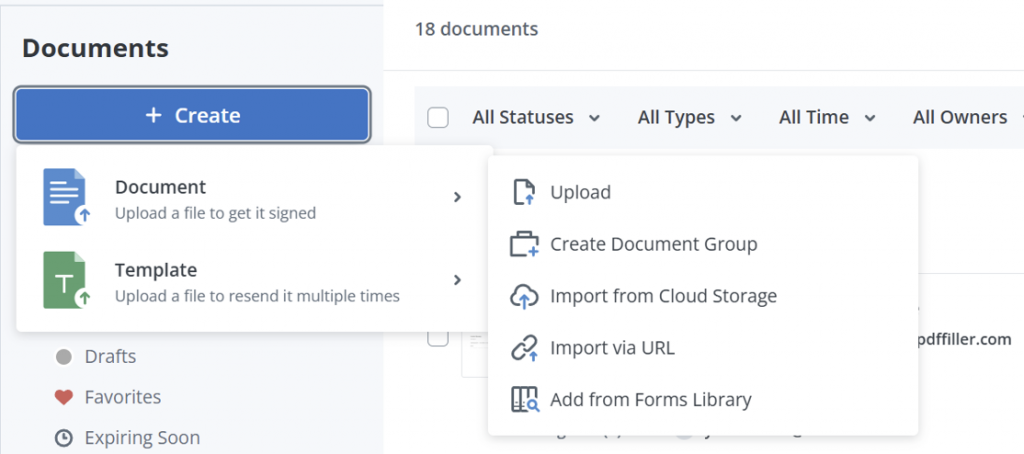
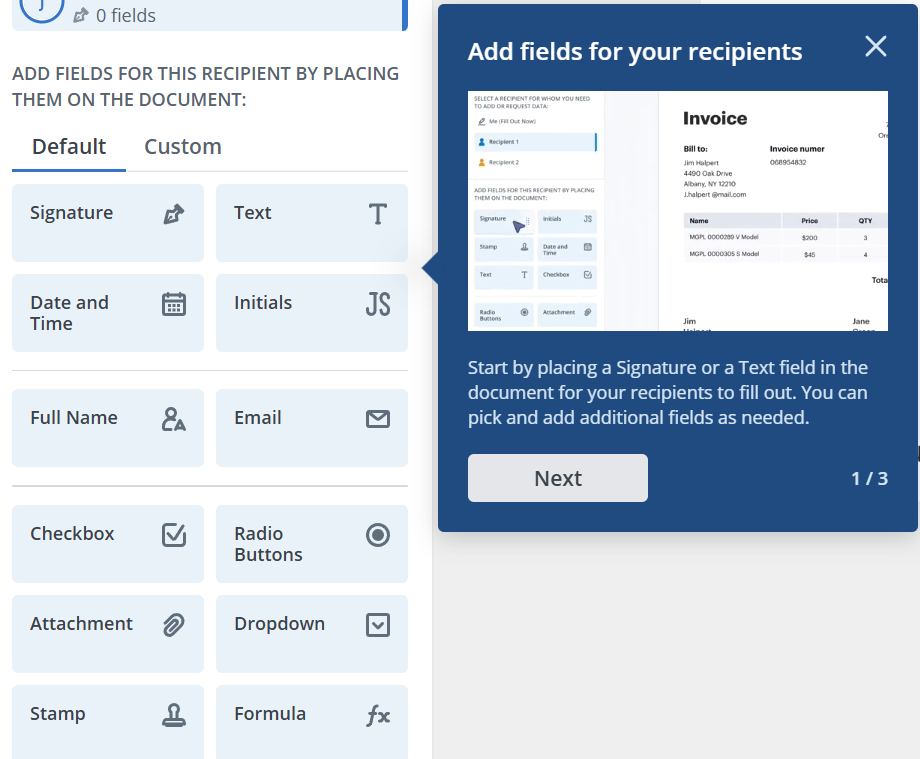
- Prepare the letter for signing by adding all the needed fields and assigning them to collaborators.
4. Access the completed document on your dashboard.
5. Click the Notarize option for your chosen document.

6. Pass document IDs, signer names, and email addresses to the Notarize service via the SignNow API.
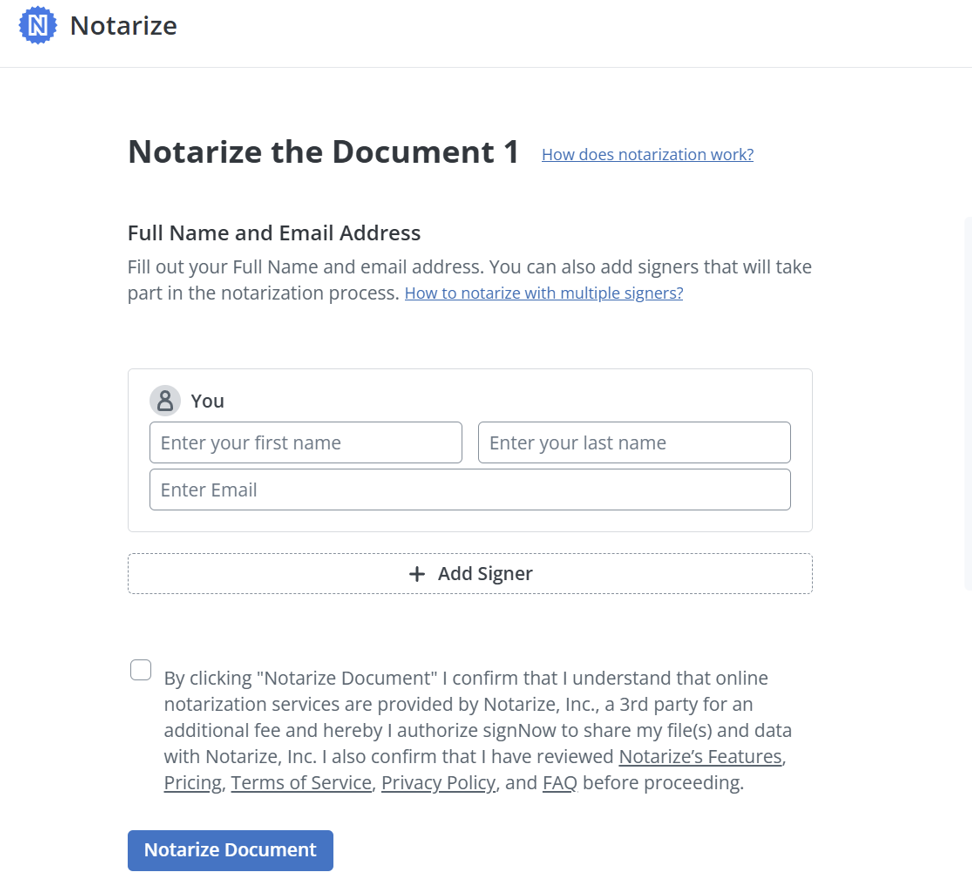
- The signer is invited to a live video session with a commissioned online notary.
- The notary verifies identities, witnesses the electronic signature, confirms the document was signed willingly, and applies a digital seal.
- The notarized document and audit trail are returned to SignNow automatically.
This directly answers common questions like “can an electronic signature be notarized?” and “is electronic notary legal?” because the notarization itself is performed by a state-authorized notary using an approved remote online notarization platform.
Built for real-world, multi-signer use cases
Many organizations don’t just need a single signer. The SignNow–Notarize integration supports:
- Up to 10 signers per notarization session, including the initiator
- Signers joining from different locations, devices, and time zones
- Optional co-location, where multiple signers appear with the notary on the same device
From a legal standpoint, this helps ensure each electronic signature for notary purposes is properly witnessed and recorded, even in complex, multi-party transactions.
In-person, mobile, and online notarization compared
Notarized letters can be signed in person at a bank or office, through a mobile notary who travels to you, or remotely online through a live video session.
| Method | Typical cost | Typical turnaround |
| In-person notarization at a bank, courthouse, shipping store, or notary office | $2-$25 per signature, capped by state law | Same day, subject to notary availability |
| Mobile notary | $40-$125+ per visit, including travel | Same day to next day, by appointment |
| Remote online notarization | $25-$50 per notarization | Minutes, on demand |
The mobile option remains sizable on its own. Future Market Insights valued the U.S. mobile notary public market at approximately $0.5 billion in 2025, reflecting steady demand for on-location notarization even as RON usage grows.
RON’s legal reach and recognition
RON’s legal reach has expanded quickly. A permanent RON-authorizing statute is now in effect in roughly 45 states plus Washington, D.C. California is an exception: its permanent RON statute is not scheduled to take effect until January 1, 2030. South Dakota, Tennessee, and Texas have not enacted their own RON statutes yet, though they still accept remotely notarized documents from other states for recording, consistent with the state-by-state landscape SignNow tracks on its eSignature legality pages.
At the federal level, the SECURE Notarization Act (H.R. 1777), introduced in March 2025, would set national minimum standards for RON in real estate transactions and require states to recognize notarizations performed by RON-commissioned notaries from other states. As of this writing, it remains a proposed bill and has not been signed into law.
Once a letter is notarized online, the signing session itself becomes part of a record, not just a one-time event. SignNow keeps a document history and audit trail for every document: an append-only log of views, authentication, signatures, and completions, each with a timestamp, role, email, and IP address attached.
That record is what a business points to later if a signature is ever questioned, alongside the notarial certificate itself, and it sits on the same SignNow security and compliance program that covers SOC 2 Type II and GDPR.
“We felt most comfortable investing with SignNow given their SOC 2 certification and strict focus on ESIGN and UETA act compliance. Deploying SignNow across all functions of our growing organization and within critical Office 365 environments has simplified our entire workflow.”
— Dan Rotelli, CEO, BIS
Notarized letter vs certified letter
A notarized letter and a certified letter solve two different problems.
A notarized letter has been verified by a notary public, who confirms the signer’s identity and willingness before certifying the signature. A certified letter is a U.S. Postal Service mail option that provides proof the letter was sent and, with a return receipt, proof it was delivered.
One is about who signed a document; the other is about whether a document reached its recipient. A letter can be both notarized and sent by certified mail, but neither process substitutes for the other, and a postal worker cannot notarize a document the way a commissioned notary can.
A common real-world combination is a notarized consent letter that is then sent by certified mail so the sender has proof of both who signed it and that the recipient received it.
Notary fees and costs
Notary fees are set by state law and typically run from $2 to $25 per signature for standard in-person notarization. The exact cap varies by state: New York limits notaries to $2 per signature, while Maine allows up to $25, based on state-by-state notary fee limits.
Many banks and credit unions waive the fee entirely for their own account holders. Mobile notaries typically charge $40 to $125 or more once travel is included, and remote online notarization sessions usually cost $25 to $50, reflecting the added identity-verification technology involved.
These figures cover the notarial act itself. They do not include separate costs some readers confuse with notary fees, such as courier charges for physical documents, county recording fees for real estate deeds, or apostille fees for letters that need to be recognized in another country.
Final thoughts
A notarized letter helps prove that a specific person signed a document willingly and after identity confirmation by a notary public. It does not replace legal advice, but it can make important documents easier to verify, submit, and accept.
With SignNow, you can prepare, sign, and route documents for online notarization in one secure workflow. Start your free trial to see how SignNow can help you manage notarized letters and other important documents faster.
Glossary
Acknowledgment: a notarial act in which the signer confirms, in the notary’s presence, that a signature is theirs and was made willingly, most often used for deeds and powers of attorney.
Certified copy: a notary’s certification that a photocopy is an exact, complete copy of an original document; not recognized in every state, and usually reserved for records like diplomas and passports rather than letters.
Jurat: a notarial act in which the signer swears or affirms under oath that a document’s contents are true, carrying perjury risk if the statement turns out to be false.
Notary public: an official commissioned by a state government to witness signatures, verify signer identity, administer oaths, and certify documents; commissions must be renewed periodically and can be revoked for misconduct.
Remote online notarization (RON): a notarization completed over live audio-video technology instead of in person, legal under a permanent statute in most U.S. states as of 2026.
Self-authenticating document: a document that can be admitted as evidence in court without separate proof of its authenticity, a status that properly acknowledged notarized documents hold under federal evidence rules.
Apostille: a certification attached to a notarized document so it is recognized as authentic in another country that participates in the same international authentication treaty, typically required in addition to, not instead of, the original notarization.
FAQ
Can a notarized letter be rejected?
Yes, a notarized letter can still be rejected if it uses the wrong notarial act, lacks required wording, has missing signer details, or does not meet the receiving institution’s rules. For example, a visa office, court, lender, or school may require a specific notarial certificate or original document. Always confirm the exact requirements before you notarize a document to avoid delays.
Does a notarized letter need to be on paper?
Not always. Many documents are still notarized as paper documents in a notary office, bank, law office, or courthouse. However, remote online notarization allows a document notarized online to be signed, witnessed, and sealed through secure video conferencing where state law and the receiving party allow it.
Can a notary help write my notarized letter?
A notary public can explain the notarization process, verify identity, administer oaths when required, witness a signature, and complete the notarial certificate. A notary cannot provide legal advice unless they are also a qualified attorney. For legal matters, immigration documents, real estate transactions, or powers of attorney, it is safer to ask an attorney or the requesting institution for the required wording.
What ID do I need for notarization?
Most notarization appointments require a valid government-issued photo ID, such as a driver’s license, passport, or state ID. The notary uses it for identity confirmation before the notarial act is performed. Requirements vary by state, so expired, damaged, or foreign IDs may not always be accepted.
Can more than one person sign a notarized letter?
Yes, multiple parties involved in a transaction can sign the same notarized letter if each signer completes the required identity verification and signs willingly. In person, each signer usually appears before the notary. During online notarization, commissioned online notaries may support multi-signer sessions depending on the platform and state rules.
Is remote notarization accepted in every state?
Remote notarization is widely available in the U.S., but acceptance and commissioning rules still vary by state. Some states authorize online notaries directly, while others may accept documents notarized online in another state. Before using remote notarization for important documents, confirm that the receiving institution will accept the notarized document.
What should a notarized letter include?
A notarized letter should clearly identify the person signing, the purpose of the written statement, the parties involved, and any important transaction details, dates, or authorization limits. The notary then adds the notarial certificate, notary’s signature, and official seal. Do not leave blanks in the letter, because incomplete documents can be rejected.
Do banks and credit unions notarize documents?
Many banks and credit unions offer notary services, often free for account holders. Availability varies by branch, and some locations require an appointment. They may also refuse to notarize certain documents if the signer lacks proper ID, the document is incomplete, or the requested notarial act is outside their policy.
Can I notarize a copy instead of the original document?
A certified copy is a specific notarial act where the notary certifies that a copy matches the original document, and some states limit or prohibit this service for certain records. For passports, diplomas, court records, and state government documents, confirm whether a certified copy is allowed or whether another form of authentication is required.
Sources
- Federal Rule of Evidence 902(8), self-authenticating documents
- National Notary Association, 2026 Notary Fees by State
- Mortgage Bankers Association, RON Adoption Map
- NotaryLive, Remote Online Notarization Laws by State (2026)
- American Society of Notaries, Uniform Law on Notarial Acts
- Future Market Insights, Mobile Notary Public Market Report
- TL;DR
- Why does a letter need to be notarized?
- Types of notarial acts
- Types of notarized letters and common uses
- Who can notarize a letter?
- How to get a letter notarized
- How to notarize a letter using SignNow
- Built for real-world, multi-signer use cases
- In-person, mobile, and online notarization compared
- Notarized letter vs certified letter
- Notary fees and costs
- Final thoughts
- Glossary
- FAQ
- Can a notarized letter be rejected?
- Does a notarized letter need to be on paper?
- Can a notary help write my notarized letter?
- What ID do I need for notarization?
- Can more than one person sign a notarized letter?
- Is remote notarization accepted in every state?
- What should a notarized letter include?
- Do banks and credit unions notarize documents?
- Can I notarize a copy instead of the original document?
- Sources